Export Data
The Export Data dialog sets the parameters for exporting results and chromatogram data. The selected data can be exported to a file or copied to the clipboard.
The dialog is used both for automatic export and for manual export of the active chromatogram and its results. Because both workflows use the same dialog, changes made in one location also apply to the other.
The dialog can be opened from the Instrument window using Settings - Export Data... command or from the Chromatogram window using File - Export - Export Data... command.
Automatic export can be enabled on the Single Analysis - Post-run Options tab or through the Export Data column in a Sequence.
To export data directly from the Chromatogram window without opening the Export Data dialog, use the Ctrl + E shortcut.
In addition to the Export Data command, a chromatogram can also be exported using the Export Chromatogram in AIA (TXT, EZChrom) Format command (for more details see also chapter Export Chromatogram)
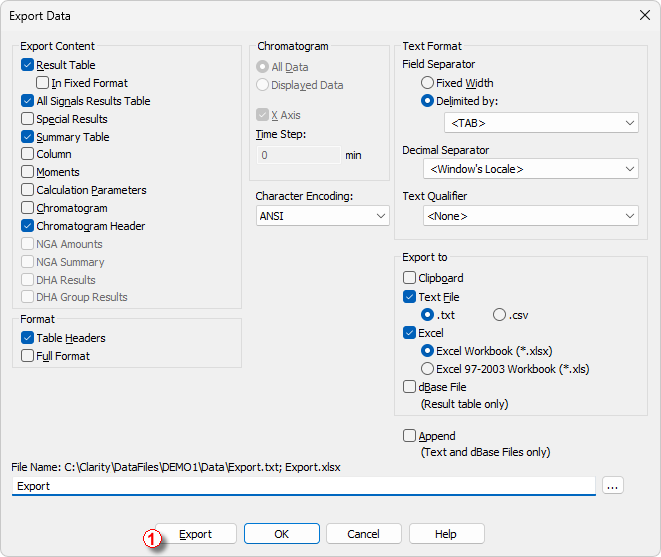
Export Data
Determines the type of data to be exported.
Exports the Results Table. Hidden columns are not exported.
Exports data in a fixed format, regardless of the current screen settings. Changes made in the Units Setup dialog are ignored, and the data is exported in default units. The export is therefore not WYSIWYG.
This option is useful when the exported data will be processed automatically by another program.
Exports the All Signals Results Table sorted by retention time.
Exports any special data given by control modules (e.g. fraction table in case of fraction collector, …).
Exports Summary Table.
Exports Column Performance table calculated at half height. This table is exported in fixed format.
Exports Column Performance table calculated from statistical moments. This table is exported in fixed format.
Exports the calculation parameters from the Method Setup - Calculation tab.
Exports current chromatogram according to settings in the Chromatogram section.
Exports chromatogram header.
Exports the Result Table from the NGA Results tab in the NGA Extension. Available only if the Instrument Type is NGA.
Exports the Summary Table from the NGA Summary tab in the NGA Extension. Available only if the Instrument Type is NGA.
Exports the Result Table from the DHA Results tab in the DHA Extension. Available only if the Instrument Type is DHA.
Exports the Group Results Table from the DHA Group Results tab in the DHA Extension. Available only if the Instrument Type is DHA.
Format
Determines the format of exported tables - presence of headers or additional information.
Exports table headers together with the exported tables.
Exports all tables in full format. Each line is extended with the file name and the date and time of creation.
Defines the format of the exported chromatogram. It is only active when Chromatogram is selected in the Export Content section.
Exports the entire chromatogram, regardless of the current selection.
Exports only the currently displayed time range of the chromatogram.
X Axis
Determines whether the exported data contains time values in the first column.
Note:
The time axis is exported with 5 decimal places precision (other data with 4 decimal places).
Determines the length of the time interval, in minutes, used to calculate each exported value. The value is calculated as the arithmetic mean of the highest and lowest point within the interval. A value lower than the chromatogram sampling rate, including zero, does not change the export. In this case, the exported chromatogram contains the same number of data points as the original chromatogram. Entering a time step longer than the chromatogram length exports a single value corresponding to the mean value for the entire chromatogram.
Caution:
The highest and lowest points equal to the highest and lowest Y-axis values within each Time Step interval. Time Step is performed on data with the Global Filter - Bunching setting applied. Time Step is not performed on raw data.
Selects the character encoding used for chromatogram export. Available options are ANSI and Unicode (UTF-8).
Defines the output format of exported text data.
Defines how the exported items are separated.
Separates items with the number of spaces required to maintain alignment (this occurs only for disproportional letter types).
Separates items using one of the following delimiters: Comma, Semicolon or Tabulator.
Selects the decimal separator. Available options are Window’s Locale, Dot or Comma.
If an exported item, for example a Compound Name, contains a character used as the Field Separator or Text Qualifier, the item is enclosed in the selected Text Qualifier. Available options are: None, Single Quotation Marks, and Double Quotation Marks.
Automatically exports data to the clipboard.
Automatically exports data to a text file. The exported file can use either the .txt or .csv extension.
Automatically exports data to an Excel file. The Text Format settings are not applied to Excel export. The decimal separator is always based on the Windows settings. It is possible to choose between .xlsx (default, requires Excel 2016 or newer) or .xls formats (supported with Excel 97 or newer). Exporting to Excel is not supported in Starter editions of Microsoft Office.
Automatically exports data to a dBase database file. Only the results table can be exported in database format. If only dBase File is selected as the export destination, the entire dialog is grayed out and the Results Table and Full Format checkboxes are available.
Export to a dBase file with Append enabled has limitations. See File is not compatible for more information.
File specification and buttons
Controls whether exported data is appended to an existing file or written to a new file. This option is applied only to Text or dBase file.
When the File Name field is filled in, Append either appends the data to the existing file or creates a new file if the file does not exist. When the File Name field is empty, a separate file is always created for each chromatogram.
Specifies the file name used for export to a file. The full path, including the file name, is displayed above the edit field.
If the edit field is empty, a file with the same name as the exported chromatogram is created, using the appropriate export file extension. The file is saved either to the export directory set in User Options - Directories, or, if no export directory is defined, to the same directory as the chromatogram.
The file name, path, or both can be overridden manually. This override is valid only for a single export when the export path is defined in Directories, or until the Clarity Instrument window is closed.

Searches for a file or directory to be entered in the File Name field.
The Export button ① is available only when the dialog is opened from the Chromatogram window. Exports the data to the destination selected.
OK
Saves the current settings.
Cancel
Closes the dialog without saving changes.