Reprocessing whole sequence allows recalculation of results for all chromatograms in a sequence after changes to integration, calibration, or calculation parameters. This ensures that all results are consistent and reflect the current evaluation settings before further processing, reporting, or export to external systems such as LIMS.
Reprocessing does not modify raw chromatographic data. Only calculated results and derived outputs are updated.
The steps below describe a process, where Integration is reviewed and if necessary, updated manually in each chromatogram, or sequence is already measured using a method with optimized integration parameters
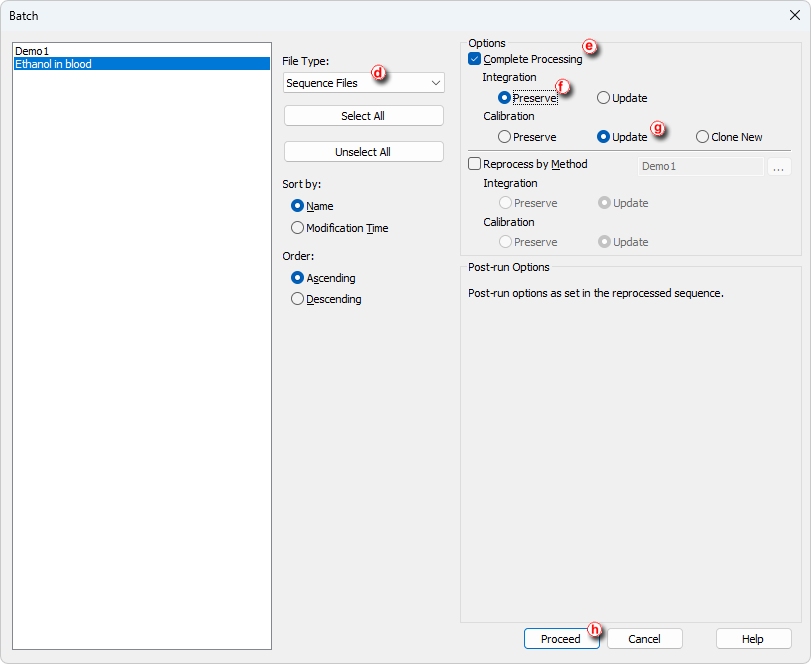
- Open the Batch dialog by using Analysis - Batch in the Instrument window.
- Set File Type to Sequence Files ⓐ.
- Select the Sequence you want to reprocess.
- Check the Complete Processing ⓑ checkbox.
- Under Complete Processing, adjust the processing behavior as required:
- Select Preserve ⓒ in the Integration to keep manually adjusted integration.
- Select Update ⓓ in the Calibration to perform recalibration using updated integration.
- Click Proceed ⓔ to start with the batch processing.
The sequence is processed row by row. All selected recalculations and post-run actions defined in the sequence are performed.
Caution:
The operations during Batch reprocessing are done row after row, injection after injection. In some situations it is necessary to perform the Complete Processing in two steps - first just the recalibrations, second the post-run actions (either using the Complete Processing again with the Integration a Calibration settings set to Preserve, or through running the post-process on selected chromatograms only through procedure described in Performing Post-run Options from Batch section). For example, if the sequence is using calibration bracketing the unknowns are measured before second standards set and if the unknowns were reported during the recalibration step, the responses from the second standard set would be missing in the report.